Raja Ampat to the Spice Islands – A 1600-Word Dive into Indonesia’s Ocean Treasure
By Tony Pigott
Our unforgettable journey through Raja Ampat, one of the most pristine marine regions in Indonesia, to the historic Spice Islands, offered some of the most breathtaking diving experiences imaginable.
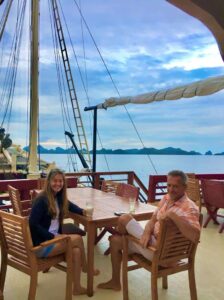
It was day three, anchored just off the coast of West Papua in the idyllic Raja Ampat archipelago, that we got our wake-up call. My wife and I were among 12 very fortunate divers on board the Seven Seas, a one-hundred-foot ironwood trading Pinisi built in Makassar and tricked out for anything a diver could wish for.
On this still, early morning in Raja Ampat, the world seemed undeniably perfect and problem-free. The sea was calm, the skies were clear, and the possibilities felt endless.
But then it happened.
On our first dive, 40 feet down, kneeling on the sandy bottom, peering through windex-clear water and backlit by the morning sun — an immense Ocean Manta appeared. At first, it looked like a ghost ship, gliding silently through the blue. Then it floated above us, blocking out the sun.
It turned and hovered, as if inspecting us. Then, from our left, a trio of Black Rays — looking very much like stealth bombers — soared in and drifted past in a silent flyby.
I defy anyone to see this and not feel a rush of awe and anxiety in equal measure. How could such creatures exist? How long do they have? And what is the future for this corner of the world — the Raja Ampat region within the Coral Triangle, home to more than 400 coral and 600 fish species; a migratory route for whales and turtles and big pelagic; the Amazon of the ocean in the words of UNESCO?
An encounter with Mantas shakes you up. It forces you to look around and ask questions.
The big picture is not pretty. According to the UN, 90 percent of the world’s fisheries are depleted or facing collapse. Coral forests are bleaching across Australia’s Great Barrier Reef because of warming water — a warning sign that even protected areas like Raja Ampat are not immune.
Signs of Hope
Next day there was the hint of an answer — when I was attacked by a school of Black Tip Sharks. They were feeding on bits of chum that had been thrown in the water near us. The biggest one took a run at my leg but was unable to gain any purchase, owing to the fact it was only 18 inches long.
The attack happened in the sandy shallows of a patrol outpost — one of many in The Misool Eco Sanctuary, one of the most successful marine protected areas in Raja Ampat, showcasing the potential of local-led conservation efforts. According to Misool Foundation, these initiatives have led to a significant rebound in reef health and fish biomass.
The beach site has several sheds, three patrol boats, and a guy with an AK-47. There is also a large mural depicting sea creatures, bank notes, and villagers, accompanied by a brief explanation comparing the ocean to a bank account: spend your savings, and then what?
Later, on the nearby island of Arborek, we meet a half dozen young researchers and volunteers from Barefoot Conservation, who have a research station on the island. They are here to benchmark the state of the reefs and try to solve some of the mysteries of the manta.
Seeing this — and encountering dozens of baby sharks — was encouraging. The collaboration between the region’s villages, environmental NGOs, and tourism operators may actually be working. But is it too little, too late?
Ancient Riches and Present Realities
It turns out the “bank” of Raja Ampat has operated successfully for a very long time.
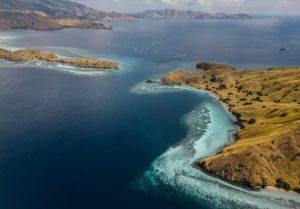
Further south, in the Misool archipelago of Raja Ampat, we moor amid jagged and massive karst islands that rise more than a thousand feet from the indigo waters. We kayak and swim through canyon-like inlets and lagoons; shallow, sandy bottoms are warm and alive with minnows and rays. Clusters of yellow orchids and Misool pitcher plants dot the sheer cliffs.
People have fished these waters for thousands of years. Around a point and into a deep lagoon, we are confronted by the remains of a cave settlement. A cliff face has fallen away, exposing the walls of a large cave — a grey rockface studded with stalactites and blackened by fire. Across the wall are two ochre-coloured cave paintings of ocean life: a giant shrimp and what appears to be a trevally.
Australian Aborigines are thought to have used these caves, drawn by the incredible abundance of the surrounding waters of Raja Ampat.
Diving nearby, around a small jetty, you get a sense of what brought them here. The site is called “Too Many Fish” for a reason. Hundreds of fusiliers hover in the shadows, so thick at times you can’t even see the pylons of the pier. We drift among them as massive humphead wrasses and barracudas patrol the perimeter.
Even a generation ago, these seas — according to the locals — were still in decent shape. But there has been a mad run on the bank since then. The rise of a fish-hungry middle class across Asia, combined with the insatiable appetite for high-end species in wealthy countries — tuna, trevally, grouper — has put extreme pressure on fish stocks.
Ocean-going trawlers have invaded the length of Indonesia, to the point where the government has now resorted to capturing illegal vessels inside territorial waters — and blowing them the hell up.
Locally, the advent of cell towers, mobile phones, and cheap refrigeration has opened up international markets to thousands of village fishermen.
Every year, for example, off the coast of Seram near the island of Grogas, there is a massive aggregation of giant grouper. Several villagers in a single boat have been known to catch more than a thousand pounds in a single day. Iced and fast-packed into a speed boat to Ambon, and in just 12 hours, their catch arrives in Hong Kong, Singapore, Tokyo — and beyond.
Seeking Solutions
Exploring coral reefs while sailing from Raja Ampat to the Spice Islands revealed a paradise for divers.
To avert disaster, local government, the Seven Seas, nearby villagers, and a bank account of the traditional kind have come together to try and establish a conservation zone around Grogas.
Can it work?
Are the best solutions for restoring the oceans bottom-up — no pun intended? Community-led conservation solutions that can establish a balanced and sustainable fishery and livelihood, healthy reefs, sustainable catches, extraordinary diving, and the revenues it attracts?
Can “local” resist the forces of “big,” distant markets and powerful, profit-hungry business?
Final Stop: The Spice Islands
The last leg of our trip may hold the answer.
We head 100 miles south to the Banda Neira archipelago — a cornerstone of the Coral Triangle, near Raja Ampat, in places more than 8,000 metres deep, and the epicenter of the greatest global trade frenzy of the 17th century. If Banda’s colonial history is any indication, the prospects for ocean life here are pretty ugly.
For decades, nutmeg was the most valuable commodity on earth, grown only in the unique microclimate of the tiny nearby islands of Rhun and Ai — the source of great wealth and great mayhem.
The walls of the original Dutch fortress and the town square of Banda are still here, marking the site of a mass slaughter of Banda’s elite at the hands of samurai assassins hired by the Dutch to show the locals who was really in charge. All this for something to spark up your mutton roast.
One big reason for this madness lies five miles out: the tiny island of Rhun.
A dozen fishing boats lie at anchor in front of a village that meanders parallel to the shore. The walkway takes you past colourful bungalows, a long war canoe in need of repairs, baskets of drying nutmeg, and finally the front door of the modest, white stucco “Manhattan 2 Guest House.”
If you’re bothered by the Dutch colonists and their ways, it may give you pleasure to know that in 1676, in order to secure the legal rights to Rhun — which the British never formally relinquished — the Dutch signed over their claims to another island: Manhattan. Sweet, really.
The Dutch held on in Banda and across Indonesia, including areas near Raja Ampat, until 1945, when history finally caught up with them — a history far more relevant to the future than the Dutch version.
One of the great architects of Indonesia’s independence was Mohammed Hatta, who was banished to Banda before the war and later became the country’s first vice president.
Fortunately, it is his legacy of resilience and defiance that seems to define Banda today more than anything courtesy of the Dutch, just as the spirit of Raja Ampat endures as a symbol of natural wealth and hope.
A Glimpse of Hope
Today, Banda and the surrounding islands have forged a comprehensive and successful conservation coalition.
In Rhun, Ai, and the aptly renamed island of Hatta, the residents have established a three-island ocean protection zone, limiting commercial fishing. Across the archipelago, there is also a sea protection zone plan, waste management programs, and education in sustainable fishing.
Then there is nature itself.
One of our last and most dramatic dives is at the foot of Gunung Api — Fire Mountain. On May 19, 1988, the mountain erupted, sending an avalanche of lava into Banda’s harbor, completely destroying 70,000 square metres of coral reef.
Today, the mountainside down to the water’s edge is still a massive pile of black rubble. But underwater, to the amazement of marine scientists, the coral rebounded
Follow us on instagram or Contact Us for more information about