Seven Seas opens the storybook on coral reef survival – By Rod Salm.
Seven Seas opens the storybook on coral reef survival
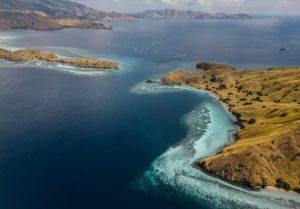
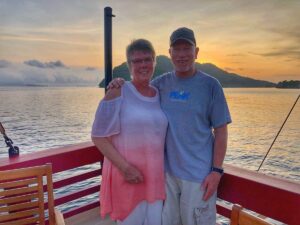
Since “retiring” one year ago, my wife Suze and I have put together three trips to Indonesia. We were there a month each time, two weeks of which were aboard the liveaboard Seven Seas exploring remote islands both above, but mostly below, the seas. Surrounded as we are on such trips by interesting and interested people makes each trip special: we’ve seen volcanoes, both quiescent and boisterous, traditional villages, cultures, practices, dance, arts, and architecture.
But most of all, we’ve seen coral communities that don’t even know they are supposed to be stressing from climate change. They are vibrant and robustly resilient. Some have ancient corals, the true methuselahs: boulder corals hundreds of years old, and table corals 50, 60, even 70 years old, which is significant for these most susceptible of corals.
All the while, I do what I’ve always done: keep my eyes wide open, try to see, really see, what I’m looking at, think about what I see, and ponder what it means for the future of coral reef survival and how we manage these fragile ecosystems. Keeping hope alive can be challenging at times. But then one needs to be a zealous optimist to weather 50 years of marine ecotourism and conservation without being calloused into a cynic. While optimism can be a distraction and the equivalent of burying one’s head in the sand (only to drown later as sea levels rise), it can also be the fair wind that keeps us sailing through the doldrums of despair.
A trip such as any of the three completed this past year: Forgotten Islands, Spice Islands, and Komodo and East Flores certainly raises hope for the survival of coral reef communities and their plethora of species. And while it’s true that I focus on unraveling the story of corals’ health and resilience, the enthusiastic eagle-eyed dive guides, including the cruise director Karl and his two dive leaders, Irwan and Jeffry, easily draw attention to the weird and wonderful critters they have found.
This past trip to the best dive sites west and east of Flores met all expectations and exceeded others. Beyond the breathtaking encounters with marine life, it was also a powerful reminder of the importance of coral reef survival in these waters. Corals apart, the snorkeling with six mantas was unforgettable. While we worked hard to keep position in the current, they glided effortlessly right up to and past us, including a newborn with the fold marks on its back still visible.
Mouths wide open, they were feeding on the tidbits that the current brought with it. We saw more frogfish than I have ever seen on one dive trip; and during one dive, more Rhinopias than I’ve seen in my life, including two together. The abundance of life here truly highlights why protecting these ecosystems and ensuring coral reef survival is so essential for future generations of divers and ocean lovers.
It was uplifting to see Crystal Rock maintaining such healthy and active fish life and fortunate that Karl positioned us there at the right tide and without the distraction and confusion of boatloads of other divers. We hung-on to any rock or dead coral holdfast and watched, adrenalin surging, at the clouds of fusiliers being harried and hunted by giant trevallies and whitetip and blacktip reef sharks. The action was endless. But I must circle back to corals. There were certainly sites that were degraded and recovering from one or another form of stress.
The damage in these locations was often very old and the causes difficult to discern. It could have resulted from heat stress and bleaching, typhoons, earthquakes, tsunamis, predation by crown-of-thorns starfish, blast fishing, or combinations of these. Some rubble fields likely did result from former blast fishing; this was difficult to confirm so many years later. Unhappily too, the more popular sites with both divers and picnickers showed signs of littering and diver damage.
These challenges highlight just how fragile marine ecosystems can be, and why the focus on coral reef survival is so critical. It should be a universal rule among tour boat operators that all trash be removed, ensuring that conservation efforts and respect for the ocean go hand in hand with tourism.
The incidence of coral disease is certainly greater than it was a decade ago, indicating rising stress levels. But equally impressive was the ability of so many areas to restore themselves to former conditions, showing remarkable potential for coral reef survival if activities on these reefs are carefully managed. One special place was off the charts for magnificent coral growth.
It displayed a kaleidoscope of colorful hard corals and invertebrates, a diverse community of rapidly growing corals with good deep coloration, and strong coral recruitment – a hopeful sign that coral reef survival is possible even under increasing environmental pressures.
Table corals were abundant and diverse reaching over 2 m and had a full range of size classes, which indicated regular reproduction and settlement of these corals. Patches of reef had >100% cover by overlapping hard corals. These were all good indictors of the vibrancy, health and resiliency of this coral community.
There is much room for hope and optimism that strong management, especially control of blast fishing, will aid recovery of coral communities and enhance their resilience potential, ensuring long-term coral reef survival. We too can do our part by taking care not to contact corals or disturb any reef life. We don’t need gloves to float above the reef and should avoid lying on the substrate—especially on corals—when striving for that perfect picture. Using reef-friendly sunscreens (oxybenzone-free) also helps us diminish our impact and protect the seascapes we so cherish, further contributing to the effort toward coral reef survival.
Rod Salm
September 2018
NOTE :
To reserve your spots or see available trips, please check out our schedule page :
Schedule & Availability
Please also don’t hesitate to reach out to us at [email protected] should you require any further information or need recommendations for accommodation or flights etc. Our reservation team would be more than happy to assist. Cheers!
Follow us on instagram or Contact Us for more information about Seven Seas opens the storybook on coral reef survival.